

Is 19 A Rational Number
| Arabic: | الجمعية العامة للأمم المتحدة |
|---|---|
| Chinese: | 联合国大会 |
| French: | Assemblée générale des Nations unies |
| Russian: | Генера́льная Ассамбле́я Организации Объединённых Наций |
| Spanish: | Asamblea General de las Naciones Unidas |


United Nations General Assembly Hall at the UN Headquarters, New York City, 2006
- GA
- UNGA
- AG
Head
(President)
Parent organization
| Membership and participation |
|---|
| For two articles dealing with the membership of and participation in the General Associates, see:
|
The United Nations General Assembly (UNGA or GA; French: Assemblée générale, AG) is 1 of the 6 main organs of the Un (UN), serving every bit the main deliberative, policymaking, and representative organ of the UN. Currently in its 77th session, its powers, composition, functions, and procedures are ready out in Chapter IV of the United Nations Lease. The UNGA is responsible for the UN budget, appointing the non-permanent members to the Security Council, appointing the UN secretary-general, receiving reports from other parts of the United nations system, and making recommendations through resolutions.[ane] Information technology also establishes numerous subsidiary organs to accelerate or assist in its broad mandate.[2] The UNGA is the merely United nations organ wherein all member states take equal representation.
The Full general Assembly meets nether its president or the UN secretary-general in annual sessions at the General Assembly Building, inside the United nations headquarters in New York City. The main role of these meetings more often than not runs from September to office of January until all issues are addressed, which is frequently before the next session starts.[three] Information technology can also reconvene for special and emergency special sessions. The kickoff session was convened on 10 January 1946 in the Methodist Central Hall in London and included representatives of the 51 founding nations.
Voting in the General Assembly on certain important questions—namely recommendations on peace and security; budgetary concerns; and the election, access, suspension, or expulsion of members—is by a two-thirds majority of those nowadays and voting. Other questions are decided by a simple bulk. Each member land has i vote. Apart from the approval of budgetary matters, including the adoption of a calibration of assessment, Assembly resolutions are not binding on the members. The Assembly may make recommendations on any matters within the scope of the Un, except matters of peace and security under the Security Quango'south consideration.
During the 1980s, the Assembly became a forum for "North-South dialogue" between industrialized nations and developing countries on a range of international issues. These problems came to the fore because of the astounding growth and changing makeup of the UN membership. In 1945, the UN had 51 members, which by the 21st century nearly quadrupled to 193, of which more than than two-thirds are developing. Considering of their numbers, developing countries are often able to determine the agenda of the Assembly (using analogous groups similar the G77), the character of its debates, and the nature of its decisions. For many developing countries, the United nations is the source of much of their diplomatic influence and the chief outlet for their foreign relations initiatives.
Although the resolutions passed by the General Assembly do not have the bounden forces over the member nations (autonomously from budgetary measures), pursuant to its Uniting for Peace resolution of November 1950 (resolution 377 (V)), the Assembly may also take activeness if the Security Council fails to act, owing to the negative vote of a permanent member, in a case where there appears to be a threat to the peace, breach of the peace or human action of aggression. The Associates can consider the matter immediately with a view to making recommendations to Members for collective measures to maintain or restore international peace and security.[four]
History [edit]

Methodist Central Hall, London, the location of the first meeting of the United Nations Full general Associates in 1946.[5]
The commencement session of the Un General Assembly was convened on 10 January 1946 in the Methodist Central Hall in London and included representatives of 51 nations.[5] The next few annual sessions were held in different cities: the 2nd session in New York Urban center, and the third in Paris. It moved to the permanent Headquarters of the United Nations in New York City at the get-go of its seventh regular annual session, on 14 October 1952. In December 1988, in order to hear Yasser Arafat, the General Assembly organized its 29th session in the Palace of Nations, in Geneva, Switzerland.[6]
Membership [edit]
All 193 members of the United nations are members of the General Assembly, with the add-on of the Holy Meet and Palestine as observer states. Farther, the United Nations General Assembly may grant observer status to an international organization or entity, which entitles the entity to participate in the work of the United Nations General Assembly, though with limitations.
Agenda [edit]
The agenda for each session is planned upwards to seven months in advance and begins with the release of a preliminary list of items to be included in the provisional calendar.[vii] This is refined into a provisional agenda 60 days before the opening of the session. After the session begins, the final agenda is adopted in a plenary coming together which allocates the work to the diverse Main Committees, who later submit reports back to the Associates for adoption by consensus or by vote.
Items on the agenda are numbered. Regular plenary sessions of the General Assembly in recent years have initially been scheduled to be held over the course of simply 3 months; however, additional workloads take extended these sessions until only short of the next session. The routinely scheduled portions of the sessions normally embark on "the Tuesday of the tertiary week in September, counting from the outset week that contains at least ane working day", per the UN Rules of Procedure.[eight] The last two of these Regular sessions were routinely scheduled to recess exactly 3 months later on[ix] in early Dec merely were resumed in January and extended until just before the offset of the following sessions.[10]
Resolutions [edit]
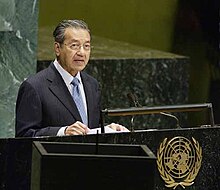

Russian President Dmitry Medvedev addresses the 64th session of the Un General Assembly on 24 September 2009
The Full general Assembly votes on many resolutions brought forth by sponsoring states. These are generally statements symbolizing the sense of the international community about an array of globe issues.[eleven] Most General Associates resolutions are not enforceable every bit a legal or practical affair, because the General Assembly lacks enforcement powers with respect to virtually bug.[12] The Full general Associates has the authority to make final decisions in some areas such equally the United nations budget.[13]
The Full general Assembly can also refer an issue to the Security Quango to put in place a binding resolution.[14]
Resolution numbering scheme [edit]
From the First to the Thirtieth General Assembly sessions, all General Assembly resolutions were numbered consecutively, with the resolution number followed by the session number in Roman numbers (for example, Resolution 1514 (Fifteen), which was the 1514th numbered resolution adopted by the Assembly, and was adopted at the Fifteenth Regular Session (1960)). Beginning in the Thirty-First Session, resolutions are numbered past individual session (for example Resolution 41/10 represents the tenth resolution adopted at the Twoscore-First Session).[ citation needed ]
Budget [edit]
The General Associates besides approves the upkeep of the United Nations and decides how much coin each member state must pay to run the organization.[15]
The Charter of the United Nations gives responsibleness for approving the budget to the General Assembly (Chapter Iv, Article 17) and for preparing the budget to the secretary-general, as "main administrative officer" (Affiliate XV, Commodity 97). The Lease also addresses the non-payment of assessed contributions (Affiliate IV, Article nineteen). The planning, programming, budgeting, monitoring, and evaluation cycle of the United Nations has evolved over the years; major resolutions on the process include Full general Assembly resolutions: 41/213 of 19 December 1986, 42/211 of 21 December 1987, and 45/248 of 21 December 1990.[16]
The budget covers the costs of United Nations programmes in areas such every bit political affairs, international justice and police force, international cooperation for development, public information, human rights, and humanitarian diplomacy.
The main source of funds for the regular budget is the contributions of member states. The scale of assessments is based on the capacity of countries to pay. This is determined by because their relative shares of total gross national product, adjusted to take into account a number of factors, including their per capita incomes.
In addition to the regular budget, member states are assessed for the costs of the international tribunals and, in accordance with a modified version of the basic scale, for the costs of peacekeeping operations.[17]
Elections [edit]
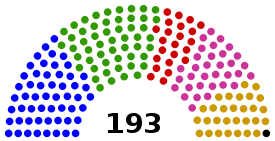
Division of the General Assembly by membership in the five United Nations Regional Groups:
The Group of African States (54)
The Grouping of Asia-Pacific States (54)
The Group of Eastern European States (23)
The Group of Latin American and Caribbean States (33)
The Group of Western European and Other States (28)
No group
The General Associates is entrusted in the Un Lease with electing members to various organs within the Un system. The procedure for these elections can exist found in Department xv of the Rules of Process for the General Assembly. The almost important elections for the General Associates include those for the upcoming President of the General Assembly, the Security Council, the Economic and Social Quango, the Human Rights Council, and the International Courtroom of Justice. Nearly elections are held annually, with the exception of the election of judges to the ICJ, which happens triennially.[18] [19]
The Assembly annually elects v not-permanent members of the Security Council for 2-year terms, 18 members of the Economic and Social Council for three-year terms, and 14–xviii members of the Human being Rights Council for three-twelvemonth terms. It besides elects the leadership of the next General Assembly session, i.due east. the side by side President of the General Assembly, the 21 Vice-Presidents, and the bureaux of the six main committees.[18] [twenty] [21]
Elections to the International Courtroom of Justice take place every three years in order to ensure continuity within the court. In these elections, v judges are elected for nine-year terms. These elections are held jointly with the Security Council, with candidates needing to receive an absolute majority of the votes in both bodies.[22]
The Assembly too, in conjunction with the Security Council, selects the adjacent secretary-general of the Un. The master office of these elections is held in the Security Council, with the Full general Assembly simply appointing the candidate that receives the Council'south nomination.[23]
Regional groups [edit]
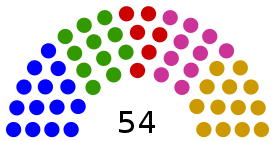
Sectionalization of seats of the Economical and Social Council based on regional grouping:
African States (14)
Asia-Pacific States (11)
Eastern European States (6)
Latin American and Caribbean States (10)
Western European and Other States (13)
The Un Regional Groups were created in order to facilitate the equitable geographical distribution of seats among the Member States in different Un bodies. Resolution 33/138 of the General Assembly states that "the composition of the diverse organs of the United Nations should exist and then constituted as to ensure their representative character." Thus, fellow member states of the United Nations are informally divided into five regions, with most bodies in the Un system having a specific number of seats allocated for each regional group. Additionally, the leadership of most bodies as well rotates between the regional groups, such every bit the presidency of the General Assembly and the chairmanship of the six main committees.[23] [24] [25]
The regional groups work according to the consensus principle. Candidates who are endorsed past them are, every bit a rule, elected by the General Assembly in any subsequent elections.[25]
Sessions [edit]
Regular sessions [edit]
The Full general Assembly meets annually in a regular session that opens on the third Tuesday of September, and runs until the post-obit September. Sessions are held at United nations Headquarters in New York unless changed past the General Associates by a majority vote.[eighteen] [26]
The regular session is separate into ii distinct periods, the principal and resumed parts of the session. During the main role of the session, which runs from the opening of the session until Christmas break in Dec, most of the work of the Associates is done. This menstruum is the Assembly's well-nigh intense period of work and includes the general fence and the majority of the work of the half-dozen Principal Committees. The resumed function of the session, however, which runs from January until the beginning of the new session, includes more than thematic debates, consultation processes and working grouping meetings.[27]
Full general argue [edit]


Brazilian President Dilma Rousseff delivers the opening speech at the 66th Session of the Full general Assembly on 21 September 2011, marking the first time a woman opened a United nations session[28]
The general contend of each new session of the General Assembly is held the week post-obit the official opening of the session, typically the following Tuesday, and is held without interruption for 9 working days. The general debate is a high-level issue, typically attended by Member States' Heads of Country or Government, authorities ministers and Un delegates. At the full general debate, Fellow member States are given the opportunity to enhance attending to topics or issues that they feel are of import. In addition to the general argue, in that location are also many other high-level thematic meetings, summits and informal events held during full general argue calendar week.[29] [30] [31]
The Full general debate is held in the United nations General Assembly Hall at the United nations Headquarters in New York.
Special sessions [edit]
Special sessions, or UNGASS, may be convened in three unlike means, at the request of the Security Council, at the request of a majority of Un members States or past a single member, every bit long as a majority concurs. Special sessions typically cover one single topic and end with the adoption of one or two result documents, such as a political declaration, action plan or strategy to gainsay said topic. They are likewise typically high-level events with participation from heads of land and regime, too as by government ministers. In that location have been 30 special sessions in the history of the United nations.[27] [32] [33]
Emergency special sessions [edit]
If the Security Council is unable, usually due to disagreement among the permanent members, to come to a determination on a threat to international peace and security, and so emergency special sessions can be convened in society to make appropriate recommendations to Members States for commonage measures. This power was given to the Assembly in Resolution 377(V) of 3 Nov 1950.[27] [34] [35]
Emergency special sessions can be called by the Security Council, if supported by at least seven members, or past a bulk of Member States of the United Nations. If plenty votes are had, the Assembly must meet within 24 hours, with Members beingness notified at to the lowest degree twelve hours before the opening of the session. There accept been 11 emergency special sessions in the history of the United nations.[18]
Subsidiary organs [edit]
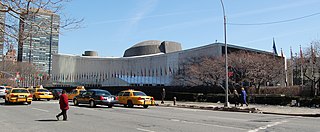
The United Nations General Associates building

The General Associates subsidiary organs are divided into five categories: committees (30 total, six main), commissions (six), boards (seven), councils (four) and panels (1), working groups, and "other".
Committees [edit]
Main committees [edit]
The primary committees are ordinally numbered, i–6:[36]
- The First Committee: Disarmament and International Security (DISEC) is concerned with disarmament and related international security questions
- The Second Committee: Economic and Fiscal (ECOFIN) is concerned with economic questions
- The Third Committee: Social, Cultural, and Humanitarian (SOCHUM) deals with social and humanitarian issues
- The Fourth Committee: Special Political and Decolonisation (SPECPOL) deals with a variety of political subjects not dealt with past the First Committee, as well as with decolonization
- The 5th Commission: Authoritative and Budgetary deals with the administration and budget of the United Nations
- The Sixth Committee: Legal deals with legal matters
The roles of many of the chief committees have changed over fourth dimension. Until the late 1970s, the First Commission was the Political and Security Committee (POLISEC) and there was too a sufficient number of boosted "political" matters that an additional, unnumbered principal committee, called the Special Political Committee, too sabbatum. The Fourth Committee formerly handled Trusteeship and Decolonization matters. With the decreasing number of such matters to be addressed every bit the trust territories attained independence and the decolonization move progressed, the functions of the Special Political Committee were merged into the Quaternary Committee during the 1990s.
Each main committee consists of all the members of the Full general Associates. Each elects a chairman, iii vice chairmen, and a rapporteur at the get-go of each regular General Associates session.
Other committees [edit]

These are not numbered. Co-ordinate to the General Assembly website, the most important are:[36]
- Credentials Committee – This committee is charged with ensuring that the diplomatic credentials of all United nations representatives are in order. The Credentials Committee consists of ix Member States elected early on in each regular General Assembly session.
- General Commission – This is a supervisory committee entrusted with ensuring that the whole meeting of the Associates goes smoothly. The Full general Commission consists of the president and vice presidents of the current Full general Assembly session and the chairman of each of the 6 Main Committees.
Other committees of the Full general Assembly are enumerated.[37]
Commissions [edit]
At that place are half dozen commissions:[38]
- United Nations Disarmament Commission, established by GA Resolution 502 (VI) and S-10/2
- International Ceremonious Service Commission, established by GA Resolution 3357 (XXIX)
- International Law Committee, established by GA Resolution 174 (Ii)
- United Nations Committee on International Merchandise Constabulary (UNCITRAL), established by GA Resolution 2205 (XXI)
- Un Conciliation Commission for Palestine, established by GA Resolution 194 (III)
- United Nations Peacebuilding Commission, established by GA Resolution threescore/180 and UN Security Quango Resolutions 1645 (2005) and 1646 (2005)
Despite its name, the former United Nations Commission on Human Rights (UNCHR) was really a subsidiary torso of ECOSOC.
Boards [edit]
There are vii boards which are categorized into two groups: a) Executive Boards and b) Boards[39]
Executive Boards [edit]
- Executive Board of the United Nations Children's Fund, established by GA Resolution 57 (I) and 48/162
- Executive Board of the United Nations Evolution Programme and of the United Nations Population Fund, established by GA Resolution 2029 (XX) and 48/162
- Executive Board of the Earth Food Program, established by GA Resolution 50/eight
Boards [edit]
- Board of Auditors, established by GA Resolution 74 (I)
- Trade and Development Lath, established past GA Resolution 1995 (Xix)
- United nations Joint Staff Alimony Board, established by GA Resolution 248 (Three)
- Advisory Board on Disarmament Matters, established by GA Resolution 37/99 K
Councils and panels [edit]
The newest quango is the Un Human Rights Council, which replaced the aforementioned UNCHR in March 2006.
At that place are a full of four councils and one panel.[40]
Working Groups and other [edit]
In that location is a varied group of working groups and other subsidiary bodies.[41]
Seating [edit]
Countries are seated alphabetically in the General Associates according to English translations of the countries' names. The country which occupies the front-near left position is determined annually by the secretary-full general via ballot draw. The remaining countries follow alphabetically later on it.[42]
Reform and UNPA [edit]
On 21 March 2005, Secretary-General Kofi Annan presented a report, In Larger Freedom, that criticized the General Assembly for focusing and so much on consensus that it was passing watered-downwards resolutions reflecting "the lowest common denominator of widely unlike opinions".[43] He also criticized the Assembly for trying to address too broad an agenda, instead of focusing on "the major noun issues of the day, such as international migration and the long-debated comprehensive convention on terrorism". Annan recommended streamlining the General Assembly's agenda, commission structure, and procedures; strengthening the part and potency of its president; enhancing the function of civil order; and establishing a machinery to review the decisions of its committees, in order to minimize unfunded mandates and micromanagement of the United nations Secretariat. Annan reminded Un members of their responsibility to implement reforms, if they expect to realize improvements in United nations effectiveness.[44]
The reform proposals were not taken up by the Un World Tiptop in September 2005. Instead, the Summit solely affirmed the central position of the General Assembly as the master deliberative, policymaking and representative organ of the United nations, likewise as the advisory role of the Associates in the process of standard-setting and the codification of international law. The Summit also called for strengthening the relationship between the General Associates and the other main organs to ensure better coordination on topical issues that required coordinated action by the United Nations, in accordance with their corresponding mandates.[45]
A United Nations Parliamentary Associates, or Un People's Assembly (UNPA), is a proposed addition to the United Nations Organization that eventually could allow for direct election of Un parliament members by citizens all over the world.
In the General Debate of the 65th General Assembly, Jorge Valero, representing Venezuela, said "The United Nations has exhausted its model and it is not simply a matter of proceeding with reform, the twenty-offset century demands deep changes that are simply possible with a rebuilding of this organisation." He pointed to the futility of resolutions concerning the Cuban embargo and the Middle East conflict as reasons for the UN model having failed. Venezuela besides called for the interruption of veto rights in the Security Council considering it was a "remnant of the 2d World War [it] is incompatible with the principle of sovereign equality of States".[46]
Reform of the United Nations General Assembly includes proposals to change the powers and composition of the U.N. General Assembly. This could include, for example, tasking the Associates with evaluating how well member states implement UNGA resolutions,[47] increasing the ability of the assembly vis-à-vis the United nations Security Quango, or making debates more constructive and less repetitive.[48]
Sidelines of the General Assembly [edit]
The almanac session of the United Nations Full general Assembly is accompanied past independent meetings between world leaders, meliorate known as meetings taking place on the sidelines of the Assembly meeting. The diplomatic congregation has besides since evolved into a week attracting wealthy and influential individuals from effectually the world to New York City to accost various agendas, ranging from humanitarian and environmental to business and political.[49]
See as well [edit]
- History of the United Nations
- List of current Permanent Representatives to the Un
- Reform of the United Nations
- United nations Estimation Service
- United Nations System
References [edit]
- ^ CHARTER OF THE Un: Affiliate 4 Archived 12 October 2007 at the Wayback Machine. United Nations.
- ^ Full general Associates: Subsidiary organs at Un.org.
- ^ United Nations Official Document. "The annual session convenes on Tuesday of the tertiary week in September per Resolution 57/301, Para. ane. The opening contend begins the following Tuesday". world wide web.un.org.
- ^ Full general Assembly of the Un. Un. Retrieved 12 July 2013.
- ^ a b "History of Un 1941 – 1950". United Nations. Archived from the original on 12 March 2015. Retrieved 12 March 2015.
- ^ (in French) "Genève renoue avec sa tradition de ville de paix", Le Temps, Thursday 16 Jan 2014.
- ^ "Research Guide: General Assembly". United nations. Archived from the original on 21 October 2013.
- ^ "General Associates of the United Nations".
- ^ General Assembly Adopts Work Programme for Threescore-Fourth Session, United nations Full general Associates Adopts Work Programme for Sixty-Quaternary Session
- ^ UN Plenary Meetings of the 64th Session of the UN General Assembly, Full general Associates of the United nations
- ^ "Are United nations resolutions binding? – Ask DAG!". ask.un.org . Retrieved one February 2020.
- ^ "United Nations General Assembly". Encyclopedia Britannica . Retrieved 1 Feb 2020.
- ^ "Article 17 (one) of Charter of the United Nations". 17 June 2015.
- ^ "Articles xi (two) and 11 (three) of Charter of the United Nations". 15 Apr 2016.
- ^ Population, total | Information | Table. Earth Banking concern. Retrieved 12 July 2013.
- ^ UN Security Council : Resolutions, Presidential Statements, Meeting Records, SC Press Releases Archived two December 2012 at the Wayback Car. United nations. Retrieved 12 July 2013.
- ^ United Nations Section of Management. United Nations. Retrieved 12 July 2013.
- ^ a b c d "General Assembly of the United Nations". world wide web.un.org . Retrieved 27 September 2022.
- ^ . San Francisco: United Nations. 26 June 1945 – via Wikisource.
- ^ Un (17 October 2019). "Full general Assembly Elects fourteen Member States to Human Rights Council, Appoints New Under-Secretary-General for Internal Oversight Services". United Nations Meetings Coverage & Press Releases. United nations. Retrieved 19 January 2020.
- ^ United nations (four June 2019). "Delegates Elect Permanent Representative of Nigeria President of Seventy-Fourth General Assembly by Acclamation, Also Choosing twenty Vice-Presidents". United Nations Meetings Coverage & Printing Releases. United nations. Retrieved 15 September 2019.
- ^ "Members of the Court". International Courtroom of Justice. International Courtroom of Justice. due north.d. Retrieved 19 January 2020.
- ^ a b Ruder, Nicole; Nakano, Kenji; Aeschlimann, Johann (2017). Aeschlimann, Johann; Regan, Mary (eds.). The GA Handbook: A practical guide to the United nations General Associates (PDF) (second ed.). New York: Permanent Mission of Switzerland to the United Nations. pp. 61–65. ISBN978-0-615-49660-3.
- ^ United Nations General Assembly Session 33 E 138. Question of the composition of the relevant organs of the United Nations: amendments to rules 31 and 28 of the rules of procedure of the General Assembly to rules A/RES/33/138 19 December 1978. Retrieved xix Jan 2019.
- ^ a b Winkelmann, Ingo (2010). Volger, Helmut (ed.). A Concise Encyclopedia of the United nations. Option Reviews Online. Vol. 48 (2d ed.). Leiden: Martinus Nijhoff. pp. 592–96. doi:10.5860/pick.48-0623. ISBN978-90-04-18004-eight. S2CID 159105596.
- ^ "Ordinary sessions". United nations General Assembly. Un. n.d. Retrieved 17 January 2020.
- ^ a b c Ruder, Nicole; Nakano, Kenji; Aeschlimann, Johann (2017). Aeschlimann, Johann; Regan, Mary (eds.). The GA Handbook: A practical guide to the United nations Full general Assembly (PDF) (2nd ed.). New York: Permanent Mission of Switzerland to the United nations. pp. xiv–xv. ISBN978-0-615-49660-3.
- ^ Llenas, Bryan (4 Jan 2017). "Brazil's President Rousseff to be Starting time Woman to Open up Un". Play a joke on News. New York. Retrieved 29 September 2015.
- ^ Manhire, Vanessa, ed. (2019). "Un Handbook 2019–20" (PDF). Un Handbook (Wellington, North.z.). (57th ed.). Wellington: Ministry of Foreign Diplomacy and Trade of New Zealand: 17. ISSN 0110-1951. Archived from the original (PDF) on 8 March 2021. Retrieved xviii January 2020.
- ^ "What is the general debate of the General Assembly? What is the order of speakers at the general argue?". Dag Hammarskjöld Library. Un. ten July 2019. Retrieved 17 January 2020.
- ^ "Frequently Asked Questions (FAQ)". United Nations General Assembly. United Nations. due north.d. Retrieved 17 January 2020.
- ^ . San Francisco: United nations. 26 June 1945 – via Wikisource.
- ^ "Special sessions". Un General Associates. Un. n.d. Retrieved 17 January 2020.
- ^ "Emergency Special sessions". Un General Assembly. United Nations. n.d. Retrieved 17 Jan 2020.
- ^ United Nations Full general Associates Session 5 Resolution 377. Uniting for Peace A/RES/377(Five) 3 Nov 1950. Retrieved 17 January 2020.
- ^ a b "Chief Committees". United nations Full general Assembly. United Nations. Retrieved nineteen June 2018.
- ^ "Subsidiary Organs of the General Assembly: Committees". Un General Assembly. United Nations. Retrieved 19 June 2018.
- ^ "Subsidiary Organs of the General Assembly: Commissions". United nations General Assembly. United Nations. Retrieved 19 June 2018.
- ^ "Subsidiary Organs of the Full general Assembly: Boards". United Nations General Assembly. Un. Retrieved 19 June 2018.
- ^ "Subsidiary Organs of the General Assembly: Assemblies and Councils". United nations General Associates. Un. Retrieved nineteen June 2018.
- ^ "Subsidiary Organs of the General Assembly: Working Groups". United nations General Assembly. United Nations. Retrieved nineteen June 2018.
- ^ The PGA Handbook: A practical guide to the United Nations Full general Assembly (PDF). Permanent Mission of Switzerland to the United nations. 2011. p. 18. ISBN978-0-615-49660-3. Archived from the original (PDF) on 22 Nov 2017. Retrieved xiv July 2017.
- ^ "Written report of the Secretarial assistant-Full general in Larger Freedom towards development, security and human rights for all".
- ^ "In Larger Freedom, Chapter 5". United Nations.
- ^ Johnstone, Ian (2008). "Legislation and Adjudication in the Un Security Council: Bringing down the Deliberative Deficit". American Periodical of International Law. 102. No 2 (2): 275–308. doi:10.2307/30034539. JSTOR 30034539. S2CID 144268191.
- ^ Associates, General. "Venezuela, Bolivarian Republic of H.E. Mr. Jorge Valero Briceño, Chairman of the Delegation". www.un.org.
- ^ "REVITALIZATION OF THE WORK OF THE GENERAL ASSEMBLY" (PDF). Globalpolicy.org. Retrieved eleven January 2015.
- ^ "The Part of the UN Full general Assembly". Council on Foreign Relations . Retrieved 11 January 2015.
- ^ David Gelles (21 September 2017). "It's the U.N.'s Week, only Executives Make It a Loftier-Minded Mingle". The New York Times . Retrieved 22 September 2017.
External links [edit]
- United nations General Assembly
- Webcast archive for the UN Full general Assembly
- Subsection of the overall UN webcast site
- Verbatim record of the 1st session of the United nations Full general Assembly, January. 1946
- UN Republic: hyper linked transcripts of the Un Full general Assembly and the Security Council
- Un Full general Assembly – Documentation Enquiry Guide
- Council on Foreign Relations: The Office of the United nations General Assembly

Is 19 A Rational Number,
Source: https://en.wikipedia.org/wiki/United_Nations_General_Assembly
Posted by: huntsmanenambriat.blogspot.com
0 Response to "Is 19 A Rational Number"
Post a Comment