

What Is The Locard Principle
Principles of Crime Scene Investigation
The key principle underlying crime scene investigation is a concept that has become known as Locard's Exchange Principle. It states that whenever someone enters or exits an surround, something concrete is added to and removed from the scene. This principle is by and large summed up by stating: "Every contact leaves a trace."
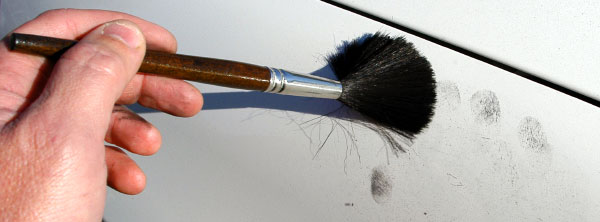
The logic behind this principle allows investigators to link suspects to victims, to physical objects, and to scenes. Any evidence that can link a person to the scene is referred to as associative show. This may include items such equally fingerprints, blood and actual fluids, weapons, pilus, fibers and the similar. This type of evidence answers the question "Who did this?"
While associative evidence links people to the identify of the crime, reconstructive prove allows investigators to proceeds an understanding of the actions that took place at the scene. A broken window, a blood spatter blueprint, bullet paths and shoe prints can all reveal what actually happened. This blazon of evidence answers the question, "How did it happen?"
To aid constitute the linkage of people and things to a scene, the investigator may also collect known substances, called control samples. These can be items such as fibers from carpet at the scene, glass fragments, soil, vegetation and other trace prove. Acquire more than about trace prove ▸ If these are plant on the suspect's clothing, in their vehicle or at their residence, it could provide circumstantial evidence linking the person to the scene.
For case, law are called to a residential neighborhood where a habitation invasion and burglary has just occurred. Investigators collect drinking glass fragments from a shattered cabinet door with a singled-out design etched into the glass. A tip leads investigators to a local man with a known history of break-in. Examination of the doubtable's wear yields glass fragments with the same singled-out pattern equally the smashed cabinet doors.
Eliminating people who could not be the perpetrator is besides important. Command samples of fingerprints and DNA are oftentimes nerveless from whatever person(s) who accept access to the scene who are not considered suspects.
Gauging the Value of Prove
It is unique - If an particular is establish that helps narrow the possibilities of who might be considered a suspect, or the fashion in which a criminal offence was committed, this evidence would be of use. Is an impression from a vehicle tire found in the dirt at the scene? The tread impression can exist compared to others to determine the type of tire that was on the auto. Is a shoe print left in the soil? The tread may help to identify the size and blazon of shoes it came from and the habiliment design could be used to match it to a specific pair. Learn more about footwear impressions and tire tracks ▸
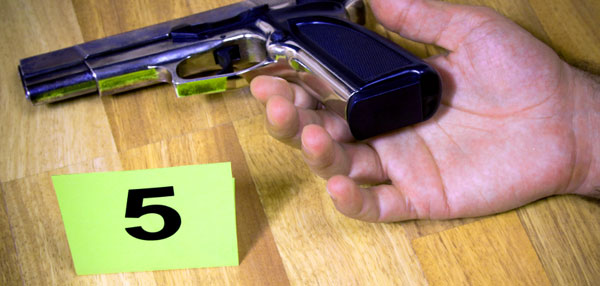
It has a depression probability of occurring by chance - Considering the mathematical probabilities will assist to determine the odds that a piece of physical evidence found at the scene could appear just by coincidence. If DNA evidence found at the scene matches a suspect, the chances are exceedingly low that another person could have left this sample. Merely even evidence that has a much higher probability—for instance, a common blazon of shoeprint that is left in the soil—is still valuable. When combined with other loftier probability evidence, these can assist narrow the list of possible parties and build a compelling case.
It is inconsistent - If an item is found that is out of place or inconsistent with the setting, or is out of grapheme for the victim—for instance if the victim was a non-smoker but a cigarette butt is found at the scene—this could be an important bit of show.
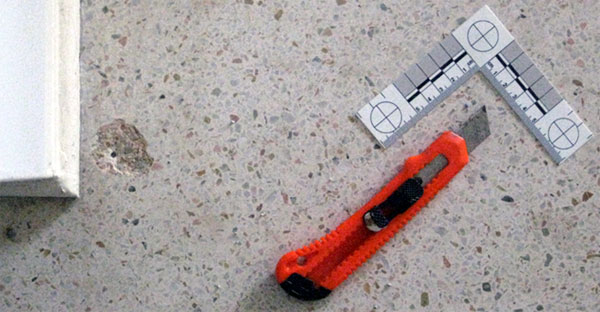
It is a physical match - If trace evidence is institute on the suspect or in his possession that matches something at the scene, this makes this particular valuable as evidence. For example, broken plastic parts or a broken fingernail that tin be matched by fracture marks can demonstrate that two pieces were once a role of the aforementioned detail.
Dorsum to top of page ▲

What Is The Locard Principle,
Source: https://www.forensicsciencesimplified.org/csi/principles.html
Posted by: huntsmanenambriat.blogspot.com
0 Response to "What Is The Locard Principle"
Post a Comment