

What Does A Windsock Measure
Clarification
A windsock, or wind cone, is a conical textile tube that resembles a giant sock. Windsocks can be used as a basic guide to current of air direction and speed.
At many airports, windsocks are lit at night, either past floodlights on superlative surrounding it or with 1 mounted on the pole shining within it.
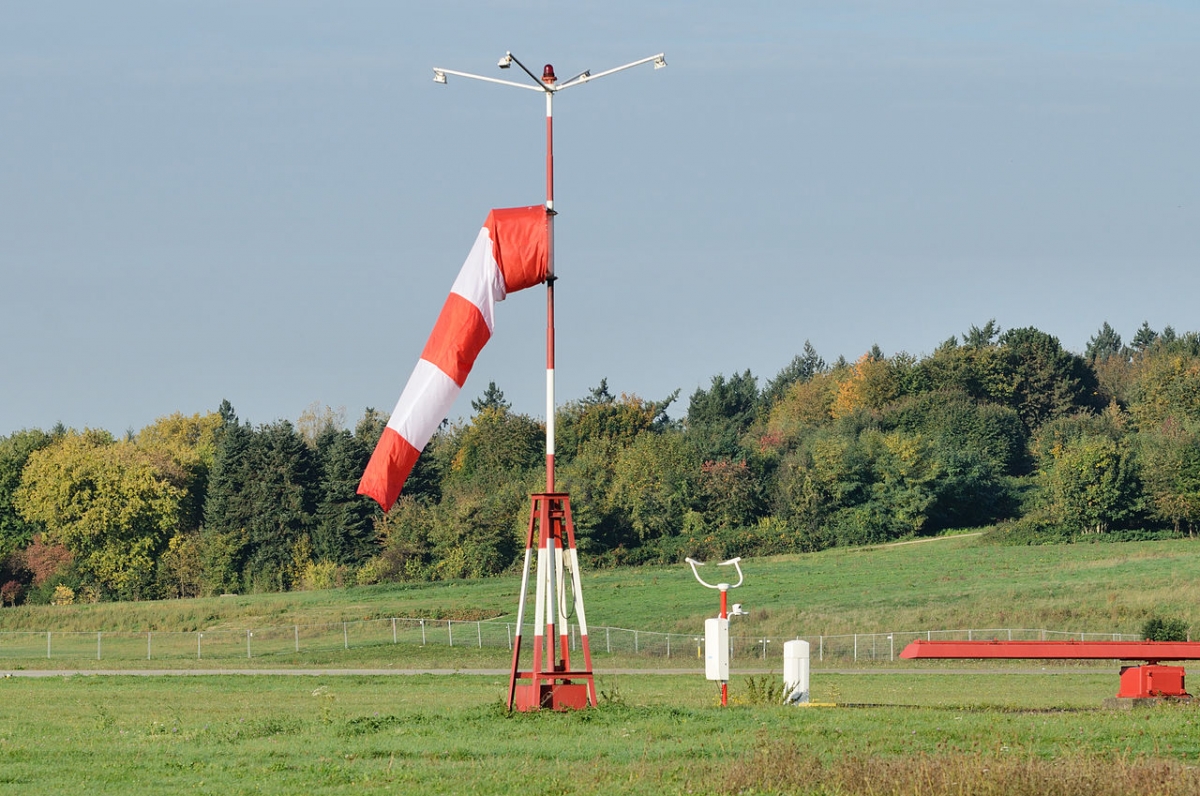
Windsock at Freiburg airport, Germany. Source: wikicommons 2012
Function
Wind direction is the reverse of the direction in which the windsock is pointing, so a windsock pointing due north indicates a southerly wind. Wind speed is indicated by the windsock's angle relative to the mounting pole; in low winds, the windsock droops; in high winds it flies horizontally.
Alternating stripes of high visibility orange and white were initially used to help to judge the speed of wind. Each stripe adds upwards 3 knots to the estimated wind speed. Yet, some circle frames mountings cause windsocks to be held open at i stop, indicating a velocity of 3 knots, fifty-fifty though anemometers would evidence no wind speed. A fully extended windsock suggests a wind speed of 15 knots (28 km/h; 17 mph) or greater.
Standards
ICAO (Annex xiv)/United kingdom CAA
Size: 3.60 m (12 ft) in length and 0.ix grand (36 inches) pharynx diameter at large stop.
Acme: At a half dozen.0 m (20 ft) mast height, the taper of the fabric windsock from the throat to the trailing terminate must be designed to cause the windsock to fully extend when exposed to a wind of 15 knots (28 km/hr or 17 mph.)
"Wind management indicators, including supplemental indicators, must be lighted if the airport is open up for air carrier operations at night."
Windsocks must rotate freely effectually a vertical shaft, must bespeak true wind direction +/- 5 degrees, and betoken 15 knots of air current when fully extended. Wind socks must be white, xanthous or orange to contrast with surroundings.
FAA
Size:
- Size ane: 2.5 g (8 ft) in length and 0.45 one thousand (xviii inches) throat diameter at large end.
- Size two: 3.60 thou (12 ft) in length and 0.9 m (36 inches) throat diameter at large end.
Height:
- FAA type L-806 support - those mounted on depression mass supporting structures - maximum of three.0 chiliad (ten ft) mast height.
- FAA type L-807 support - those mounted on rigid supporting structures - Maximum of 4.eight one thousand (16 ft) height to windsock.
Air conditioning 150/5345-27E states that a properly-functioning windsock will orient itself to a breeze of at least 3 knots (5.6 km/h; 3.5 mph) and will exist fully extended by a air current of 15 knots (28 km/h; 17 mph). In addition, air current cone assemblies must be designed to operate in wind speeds of up to 75 knots (140 km/hr or 86 mph) and ambience temperatures between -67° F (-55° C) and 131° F (+55° C.)
Transport Canada
TC AIM-AGA-Aerodromes-5.9"Wind Direction Indicators", requires that a 15-knot (28 km/h; 17 mph) wind will fully extend the windsock, a 10-knot (19 km/h; 12 mph) wind will crusade the windsock to exist 5° below the horizontal, a 6-knot (11 km/h; 6.ix mph) wind will cause the windsock to be 30° beneath the horizontal.
Related Articles
- Wind
- Wind Velocity Reporting
Further Reading
- FAA AC150/15345-27E FAA Specification for Wind Cone Assemblies

What Does A Windsock Measure,
Source: https://skybrary.aero/articles/windsock
Posted by: huntsmanenambriat.blogspot.com
0 Response to "What Does A Windsock Measure"
Post a Comment